
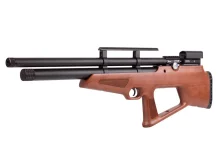



Pre-charged pneumatic, or PCP, airguns use compressed air as their source of power. Unlike spring-piston designs, a PCP system stores compressed air in a reservoir before use and releases a controlled amount of that air when the trigger is activated. This basic design has made PCP technology popular among airgun enthusiasts who value consistency, smooth operation, and repeatable performance.
Understanding PCP airgun technology starts with understanding how the air reservoir, valve, regulator, and barrel work together as one system.
How a PCP System Stores Energy
A PCP airgun contains a high-pressure air reservoir that is filled before use. Depending on the design, the reservoir may be integrated into the airgun’s frame or positioned as a larger bottle beneath the barrel.
When the trigger is activated, the valve releases a measured amount of compressed air. That burst of air provides the energy needed to propel the projectile through the barrel. Because the air is stored in advance, the firing mechanism does not need to compress a spring for every shot.
The Role of a Regulator
Some PCP systems use an internal regulator to control the pressure delivered to the firing valve. Instead of allowing reservoir pressure to directly determine the pressure used for every shot, a regulator maintains a more consistent working pressure within its operating range.
This can help produce more predictable shot-to-shot behavior. For airgun users who pay close attention to consistency, understanding whether a system is regulated or unregulated can therefore be an important part of understanding its design.
Why Reservoir Size Matters
The size of an air reservoir affects how much compressed air is available between fills. Larger reservoirs can provide greater air capacity, while smaller reservoirs can contribute to a more compact and lightweight overall design.
There is a practical trade-off between capacity and portability. A larger air cylinder may support more shots between fills, but it can also add size or weight. The appropriate configuration depends on how the airgun is intended to be used.
PCP Systems and Shot Consistency
One reason PCP technology receives so much attention is its ability to deliver relatively consistent performance when the air supply and valve system are properly managed. Regulators, valve design, reservoir pressure, projectile selection, and barrel characteristics can all influence the final result.
This is why PCP specifications should be considered as a complete system rather than evaluated by a single number. Velocity, reservoir capacity, regulator design, and overall configuration all contribute to how an airgun performs.

Understanding the Complete System
A PCP airgun also requires an appropriate method of filling the air reservoir. Depending on the setup, users may rely on a high-pressure hand pump, a dedicated compressor, or an external high-pressure air tank.
For anyone researching pre-charged pneumatic system technology, understanding these components provides a better foundation for comparing different PCP designs and determining which configuration best matches their intended use.


![[pii_email_d66aec8ab3772e6af11b]](https://wpcmagazine.com/wp-content/uploads/2022/07/pii_email_d66aec8ab3772e6af11b-100x70.webp "How to Fix [pii_email_d66aec8ab3772e6af11b] Error?")

![Fix [Pii_Email_556bd796439757dd3b82] Error](https://wpcmagazine.com/wp-content/uploads/2022/07/Pii_Email_556bd796439757dd3b82-100x70.webp "How to Fix [Pii_Email_556bd796439757dd3b82] Error on Outlook?")
![[pii_email_0f5d13fdd444218ce923]](https://wpcmagazine.com/wp-content/uploads/2022/07/pii_email_0f5d13fdd444218ce923-100x70.webp "How to resolve [pii_email_0f5d13fdd444218ce923] Outlook Error?")

